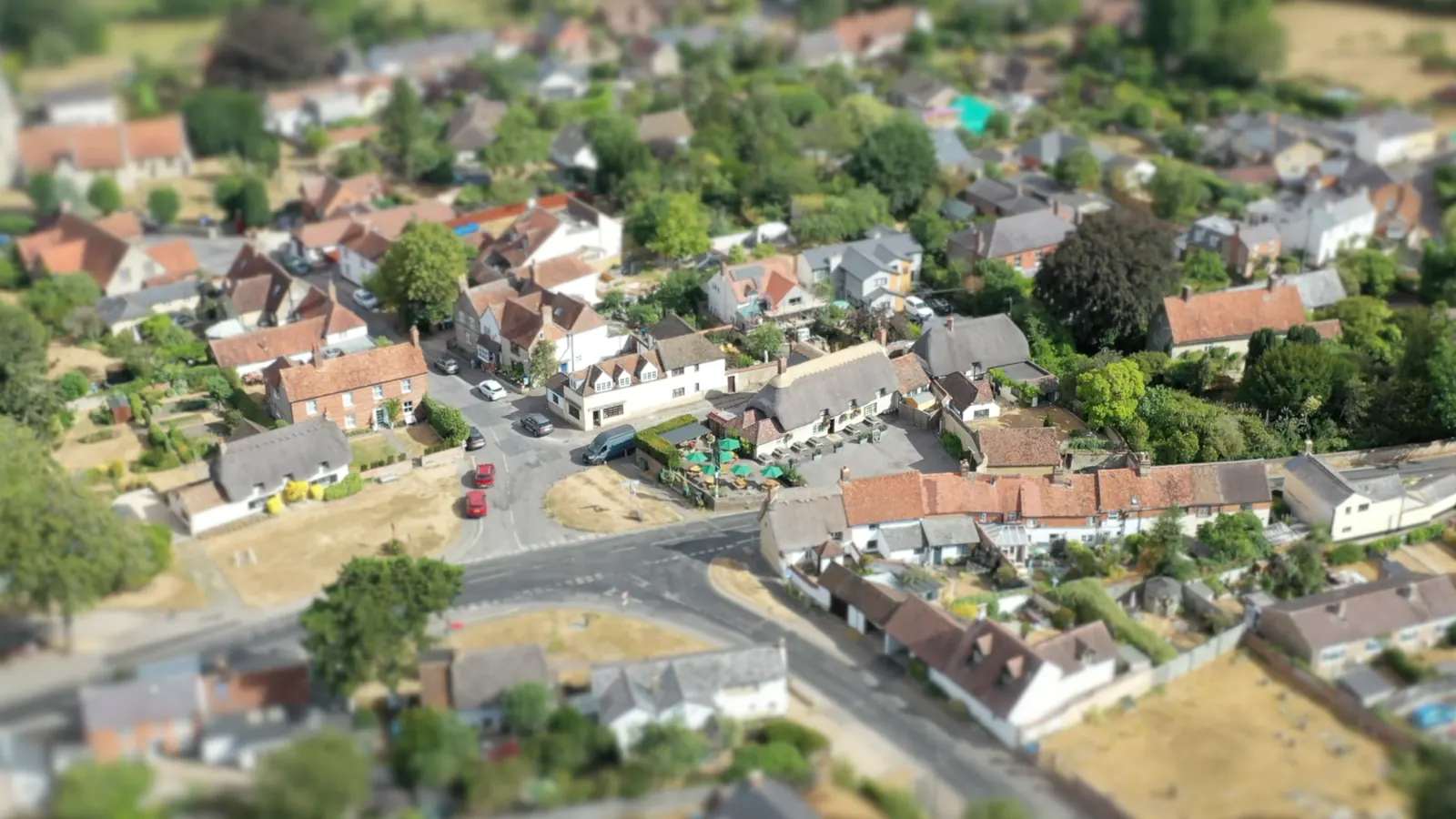
At the start of the twentieth century Cuddington had four public houses: the White Swan, the Seven Stars, the Red Lion and The Crown. In Peter Wenham’s imagined account of the 1850s, a villager counts seven. By the millennium, three of the original four had closed and become private homes.
The Swan, on Aylesbury Road, dated from the seventeenth century, with witchert walls and a thatched roof. It served as a centre for carrier wagons, stage coaches and pack horses, and had a spacious yard in front with room for stabling. In 1895 the owners sold it to the Aylesbury Brewery Company. By 1911 it had ceased to be a public house and had become a private residence, at first for William Oakley and his family. Swan House today has been renovated: the walls have been almost completely replaced with brick, and the roof is tiled.
The Seven Stars was also on Aylesbury Road. By 1911 Frederick Dormer was the landlord, and there are photographs of happy men sitting outside on the benches in summer enjoying a convivial drink. Like most innkeepers he had a second job, as a dairy farmer, and sold milk in the village. His comment when his horse fell down dead on the Lower Green, “Well, I’m blowed, she’s never done that before”, passed into village legend. By the early 1920s he had turned the Seven Stars into a private residence.
The Red Lion was probably built about 1756, and was originally called The Five Bells until the name changed in 1786. It held only a six-day licence because it stood next to St Nicholas Church, so in Wenham’s imagined account of the 1850s, families who wanted a drink on a Sunday preferred The Crown or one of the other public houses, which were open. Thomas and Annie Bailey were notable landlords from 1853 to 1877. In 1991 the new landlords renamed it Annie Bailey’s, in honour of the Victorian landlords. In 1999 it closed, and like the other two it became a private residence.
“At the millennium three of Cuddington’s original public houses had closed and become private homes.”
Peter Wenham, Public Houses in Cuddington
That left The Crown. Wenham describes it as the oldest public house in Cuddington, and its history can be traced back as far as the seventeenth century. For fifty-six years, from 1887 to 1943, it was kept by the Woodford family, and then by Sonny Rose for sixteen more. When it faced an uncertain future, the people of Cuddington came together to save it, raising £660,000 in just six weeks, and it is now owned by more than two hundred shareholders. You can read how that happened in the story of how the village saved its pub.
They are not alone in that. Plunkett UK, which supports and tracks community-owned businesses across the country, reports that they are remarkably hard to kill: roughly nine in ten are still trading over the long term. Cuddington did not need a report to tell it. It had watched three of its four pubs become houses. There is more on how community ownership works, and how well it lasts, at Plunkett UK.
Sources
Peter Wenham, Public Houses in Cuddington.
Peter Wenham, Glimpses of Cuddington’s Past, with recollections of Lil Arnott.
Alice Miller, The Village of Cuddington of a Bygone Age, 1991, as summarised in “A Village Childhood: Alice in Cuddington”, Cuddington Historical Society.
Drawn from accounts by Peter Wenham and the Cuddington Historical Society, rearranged and reworded for this page. Short quotations from Peter Wenham are marked as his. One racial nickname used of a villager has been left out.