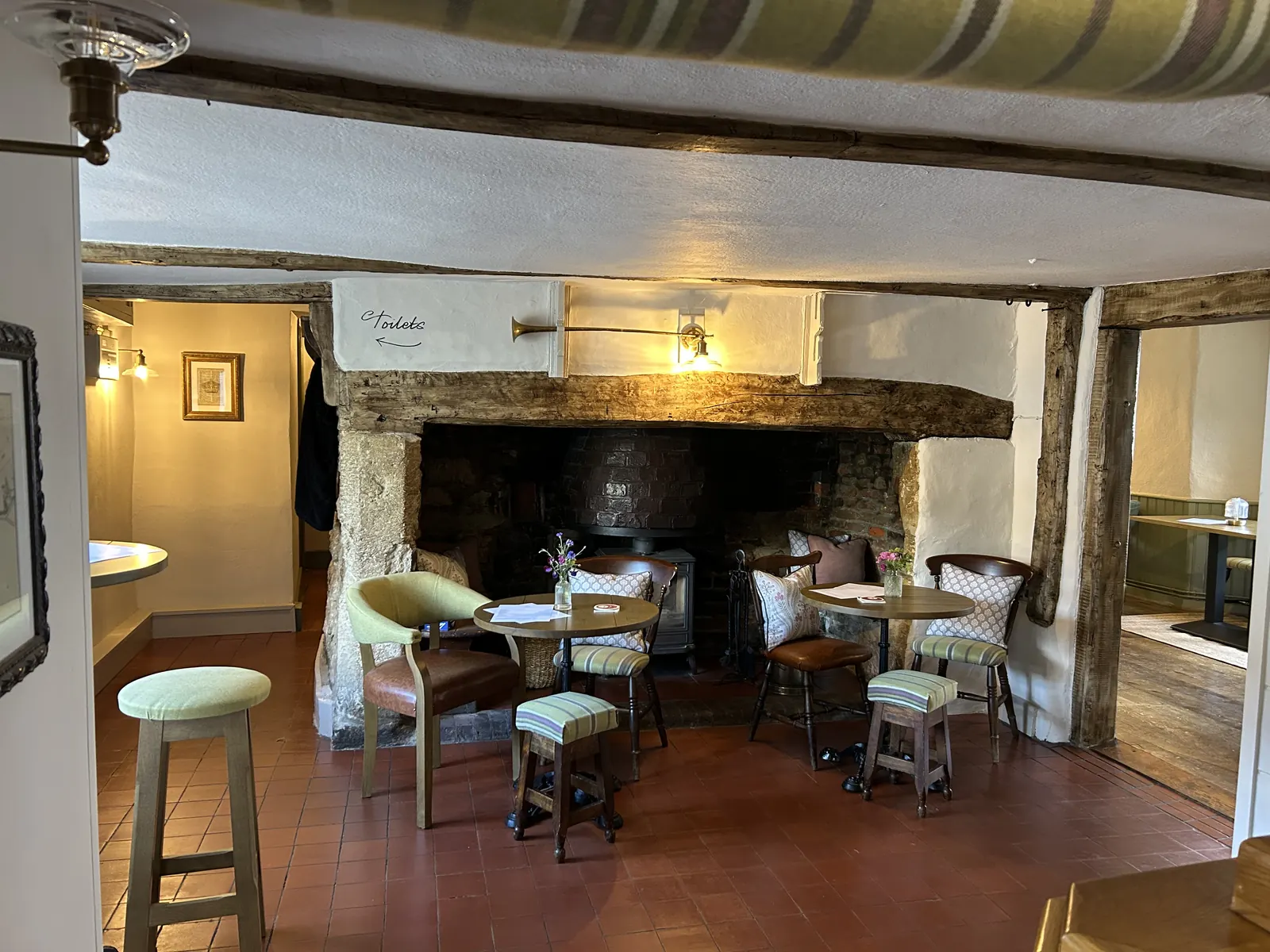
Ask the people who remembered The Crown from the inside and you get the same room across half a century: dark, warm and smoky, and full of men who wanted their glasses filled again.
Alice Miller, the landlord’s daughter, remembered a dark place that at peak times became vibrant, noisy and crowded. She remembered, too, that the drinkers would rap on the partition wall when they wanted a refill. A generation later, in Sonny Rose’s time, customers were still doing it.
“Customers engrossed in their game would rap on the wooden wall to summon more beer.”
Peter Wenham, Glimpses of Cuddington’s Past
They came for the warmth and the company, and for the games. Alice recalled dominoes, darts, cribbage, cards and shove penny, all welcome relaxation after a hard day in the fields. In the 1940s and 50s, Wenham writes, darts and dominoes were the two favourites. Even Walter, the imagined villager of the 1850s, enjoys dominoes, cards, shove penny and the occasional quiz, and prefers beer to the water from the nearby well or the pump on the Upper Green, which he says is sometimes a little tainted.
Behind the games was a great deal of hard work. Alice’s job as she grew older was to scrub the stone flags each morning, and the water for it had to be carried from a nearby well. She remembered the smell of stale beer as she washed the glasses, and clearing the hearth ready for the next fire. When the Rose family arrived in 1943, the modern amenities of their previous home in Weston Turville were, in Wenham’s words, starkly absent. Cleaning the fire grates in winter and scrubbing the flagstone floors were tedious tasks, and it was only later that a bathroom was put in for the family.
The beer came by dray. Alice remembered the Aylesbury Brewery Company draymen arriving with wooden barrels on a horse-drawn cart. Rent was paid to the same brewery, and the cost of items like cigarettes, snuff and ice cream had to be met before any profit was made. Lil Arnott recalled a delivering drayman remarking that The Crown was one of the most successful public houses in the Vale.
Sonny Rose ran a well-ordered house. He used finings to clear the beer and cleaned the pumps meticulously, and he would never discuss religion or politics. His instructions were forthright: “One drink before you start sharpens your wits, but don’t drink while serving.” All the calculations were done in his head.
There were characters. Harry Alton’s party piece was to grasp his toes in his mouth. Another regular, a deaf man from Roundhill, had a horse that could be relied on to find its own way home when its owner was befuddled. Before the birding, groups of men would gather for a drink, then string nets over hedges in Kent’s field and Dirty Lane. The bird pies, Alice noted, were very tasty. And each autumn a fish and chip seller came into the yard to buy surplus potatoes from the villagers’ allotments.
Sources
Alice Miller, The Village of Cuddington of a Bygone Age, 1991, as summarised in “A Village Childhood: Alice in Cuddington”, Cuddington Historical Society.
Peter Wenham, Glimpses of Cuddington’s Past, with recollections of Lil Arnott.
Peter Wenham, Cuddington’s Red Lion, a historical reconstruction.
Drawn from accounts by Peter Wenham and the Cuddington Historical Society, rearranged and reworded for this page. Short quotations from Peter Wenham are marked as his. One racial nickname used of a villager has been left out.